
Travis Inman
Sedalia, Missouri
Travis Inman giving a fiddle lesson, using his stage fiddle (the f-holes are covered to reduce feedback). Howard Marshall photo.
I’ll Be All Smiles Tonight
Players: Travis inman, fiddle; Charlie Walden, guitar; Patt Plunkett, piano
A country music standard popularized by the 1934 Carter Family 78 rpm record on Bluebird. Travis learned it from his fiddling uncle Othello Smith. From Travis’ CD “Missouri Fiddler” available on the Voyager Records label.
Peacock Rag
Players: Travis inman, fiddle; Charlie Walden, guitar; Patt Plunkett, piano
An Arthur Smith tune Travis learned from a Tommy Jackson record. From Travis’ CD “Missouri Fiddler” available on the Voyager Records label.
St. Anne’s Reel
Players: Travis inman, fiddle; Charlie Walden, guitar; Patt Plunkett, piano
A tune from Canadian fiddler Joseph Allard, learned from a Tommy Jackson record. From Travis’ CD “Missouri Fiddler” available on the Voyager Records label.
Travis Inman died in February 2022. The following is a chapter about Inman, among Missouri’s celebrated contest champions and fiddle teachers, from Howard Marshall’s book, Play It Old-Time (Columbia: University of Missouri Press, 2022), courtesy of Howard.
Travis Inman: “I Try to Play it Clean“
Ask Travis how he got interested in playing the fiddle, and he’ll warn you, “It’s a tale that’ll take all night to tell.” My great-aunt, Kate Swearngin, a Cherokee Indian woman, was the Oklahoma state champion back in the 1920s. My dad played the fiddle, and so did my uncles, and all kinds of relatives are musicians of one kind or another.” — Instructor profile, Bethel Youth Fiddle Camp, 2016
Travis Inman followed in the footsteps of his mentors, Kelly Jones and Pete McMahan, and took his turn as one of Missouri’s most compelling and successful contest fiddlers. Inman enjoyed a good run, four decades as an elite contest fiddler and holder of thirteen state titles. Travis won so many trophies that he lost count when the pile passed two hundred. He is a fiddler who succeeded in the contest world while staying true to his roots in old-time Missouri fiddling.[1]
The Inmans came to America from northern England. “And how they got their name, they claim that they were innkeepers and prize fighters. That’s how they got their name.” Among the first in his family to emigrate from England were brothers, Shadrach, Meshach, and Abednego Inman. “Just like the ones [names] in the Bible. And I’m not so sure which one, but one of ’em was traveling with Daniel Boone and I think it was Shadrach. Was travelin’ with Daniel Boone and he got it in the head with a tommy hawk. And that was the end of him. So, the other two brothers came on up around Nixa, Missouri. There’s a bunch of Inmans in Springfield, and some of ’em spell it Inman and some of ’em spell it Inmon.”
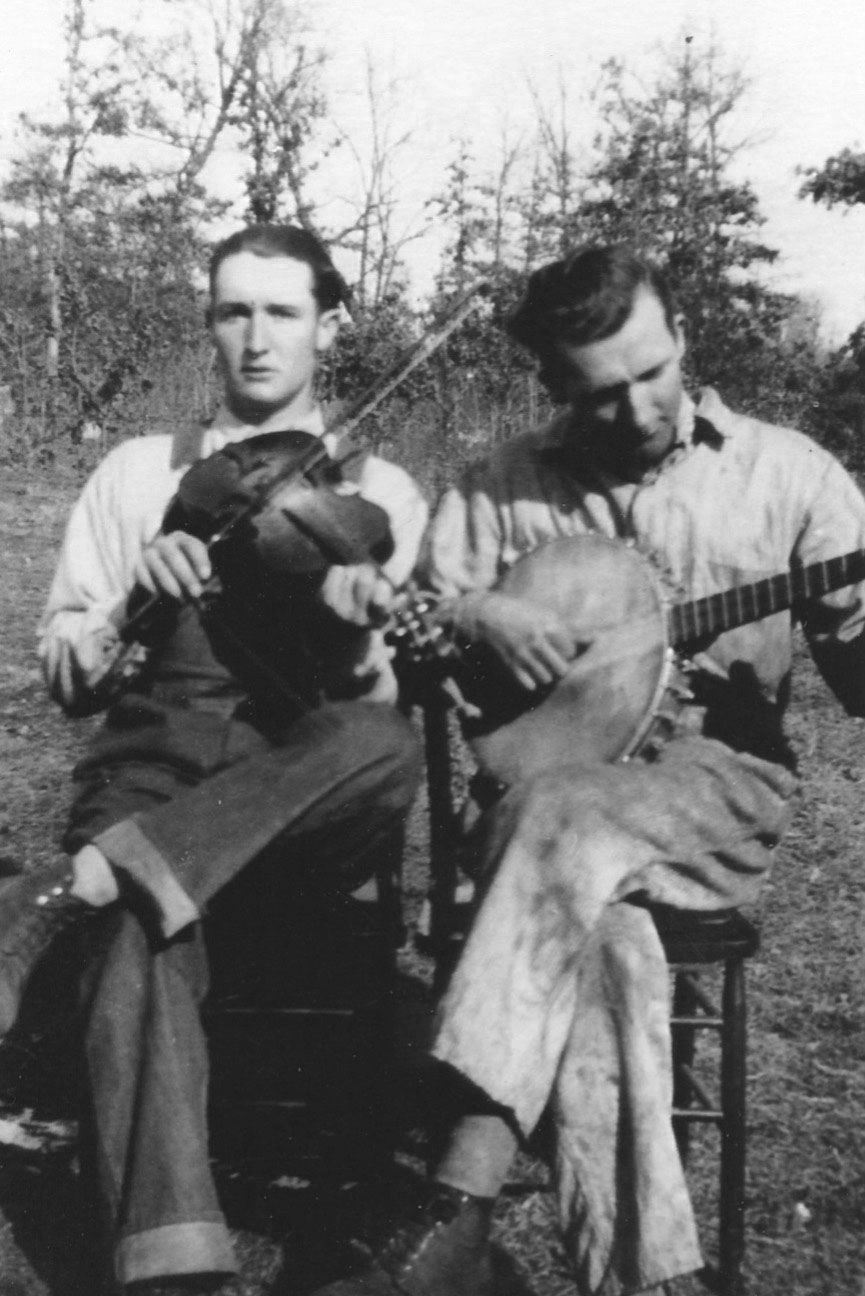
Othello Smith and his brother Cloyd Smith (banjo) after a day’s work hewing railroad ties, 1930s, near Cole Camp, Missouri. As a child, Travis Inman drew inspiration to learn to play fiddle music from watching and listening to his Uncle Othello. (Courtesy Dianne Peck)
Born in America, Travis’s grandfather was Isaac Luther (Jack) Inman, part English and part Irish. “He was a little, wiry Irishman. He was incredibly good with horses and mules.” Jack’s wife, Travis’s paternal grandmother, was Orpha Sidebottom Inman, from the Eldon, Missouri, area. Travis said that Jack Inman was a tough man and Travis saw some of that toughness in his father, Bob Inman; they were not large or tall men, but “very well put together” and “very strong.”[2] Jack Inman’s father was Golden Abriel (G.A.) Inman, recalled by family members as a “the best brawler in Arkansas” in the nineteenth century.[3] G.A. Inman was reared in Poplar Bluff in southeast Missouri and lived in Arkansas before moving to Eldon, Missouri. “I don’t know what he did over there — I think he was a tailor, making soldiers’ uniforms in a factory. Then he moved to Cole Camp and then had his family there, and that’s where my dad come from. So I was raised right there in that Cole Camp and Stover area.”
Travis’s father, Robert Forest (Bob) Inman, was born in Eldon and settled on a farm on Indian Creek in Benton County, six miles south of Cole Camp. His mother was Hazel Brown Inman.[4] Travis was born Kelly Travis Inman in April 1963. Cole Camp was founded by old-stock Missourians and by the Civil War had become a decidedly German settlement mostly of Lutherans and Low German speakers. The German community was faithful to the Union during the Civil War amidst prevailing pro-Secession communities around them, and after the war the old “southern” population was generally replaced in commercial, landowning, and political influence by the German American families who had the luck of being on the winning side. Cole Camp was famed for its cornet bands and music and today German dancing and music are revived at Maifest and sangerfest celebrations. “Wilkommen” graces downtown signs.
Travis’s mother’s people were Swearngins, Cherokee people in Tahlequah, near the reservation in northeastern Oklahoma.[5] His great-aunt, Kate Swearngin, is said to have been an Oklahoma state champion in in the 1920s and lived on the reservation.[6] Kate’s brothers John W. and Jim Swearngin came to Benton County in central Missouri, John settling near Lincoln (where his son, “Doc,” was born and reared[7]), and Jim in the Cole Camp area.
The Swearngins, they all played music, played square dances. I remember going down to Uncle John’s and Uncle Doc’s when I was a kid and listening to them play old fiddle tunes that you never hear anymore.[8] We had these gatherings when I was a kid where everyone would come over on a Friday night, and the women would bring pies and cakes and all kinds of snacks, and the musicians would start playing along before dark, and play until two or three in the morning. There was no alcohol or anything like that. Everyone just swapped stories, swapped songs and swapped recipes.[9]
First, We Learned to Play Backup
Travis (born in April 1963) started playing guitar at seven, “trying to learn chords,” so he could accompany his father’s fiddling at music parties and play hymns in church services. “I played for Dad, you know, he was a three-fingered fiddle player. He had that pinky finger [left hand, his chording hand] crippled in a motorcycle accident in France in World War Two, and never could use his little finger.”[10] What guitar backup style did Travis play for his dad?
I just played open, straight chords, that’s all we knew. Dad had an old Gibson guitar, I think it was a J-50. I learned to play on that. Dad would go to church and play his fiddle, and I’d sit there and play guitar with him. I was just a little feller. Sister played the piano. We played old gospel hymns, and we did more upbeat type stuff like “I Saw the Light” and that sort of stuff.
And Dad would go to people’s houses and entertain. He’d entertain at the nursing homes. He’d play fiddle tunes like “Soldier’s Joy” and “Ragtime Annie” and “Rubber Dolly” and stuff that you could play with three fingers that you could kinda get through. His waltzes were pretty ragged because he couldn’t use his pinky finger. But he did all right with it. We’d entertain around locally, y’know. We’d go to a pie supper.
Mrs. Inman became a devout Pentecostal and church leaders did not approve of dancing. “Dad wouldn’t play a square dance. He was a religious man. He was a part-time Pentecostal preacher. Him and Mom was very much against dances. They had done it in their earlier years, and then when they got older they got into church and they were like, y’know, it was totally different. I was raised up in a real religious household, … they was going this-a-way, and I went errrr. I was drinkin’ beer, and gettin’ in trouble in school — aw, man.”
It is not surprising that church leaders criticized fiddlers and fiddle music for the inappropriate behavior that took place at dances. Things could get crossways at a dance and yet dances were entertainment and many people’s sole occasion to leave work behind, get cleaned up, and go out and enjoy themselves. Stories about trouble at dance halls seem humorous today; people like to tell them deadpan. How bad could things get, though?
Y’know, yeah, they had that dance hall over there east of Cole Camp, and I told ya that my uncle [Othello Smith] and his brother was playin’ out there — he was my uncle by marriage, it was my mother’s sister’s husband. He played out there, him and his brother — they was old-time fiddlers, played “Dance around Molly” and all them old tunes just as good as you could play ’em. On what tunes they played, they played ’em good. His name was Othello Smith and his brother’s name was Phillip. And Othello, he talked with that ree’al heel’billy slang ree’al bad. He was a little bitty ol’ guy, just about that tall. He walked like this [gesture: limp] because he had a horse fall on him when he was younger, and broke his leg and one leg was about that much shorter than the other ‘un [gestures 2-3 inches with hand].
And he called his brother “Fee’lip” — he said, “Me and ‘fee‘lip’ was playin’ over there at that Crocker at Crocker one night, and we’s settin’ there in the doorway a-playin,” and he said, “they’ve got into it outside there, and,” he said, “that one guy just fired up a chain saw and cut the other un’s arm off. And after that they called the place ‘the chain saw inn’.”[11]
Travis Inman began playing fiddle music at twelve. At twenty-five in 1987, he won first place in the Open Division at the Saline County Fair in Marshall, Missouri. For many years the Marshall contest wase major competition and attracted numerous top-drawer contestants. (Photo by Howard Marshall)
Allure of the Contest Scene
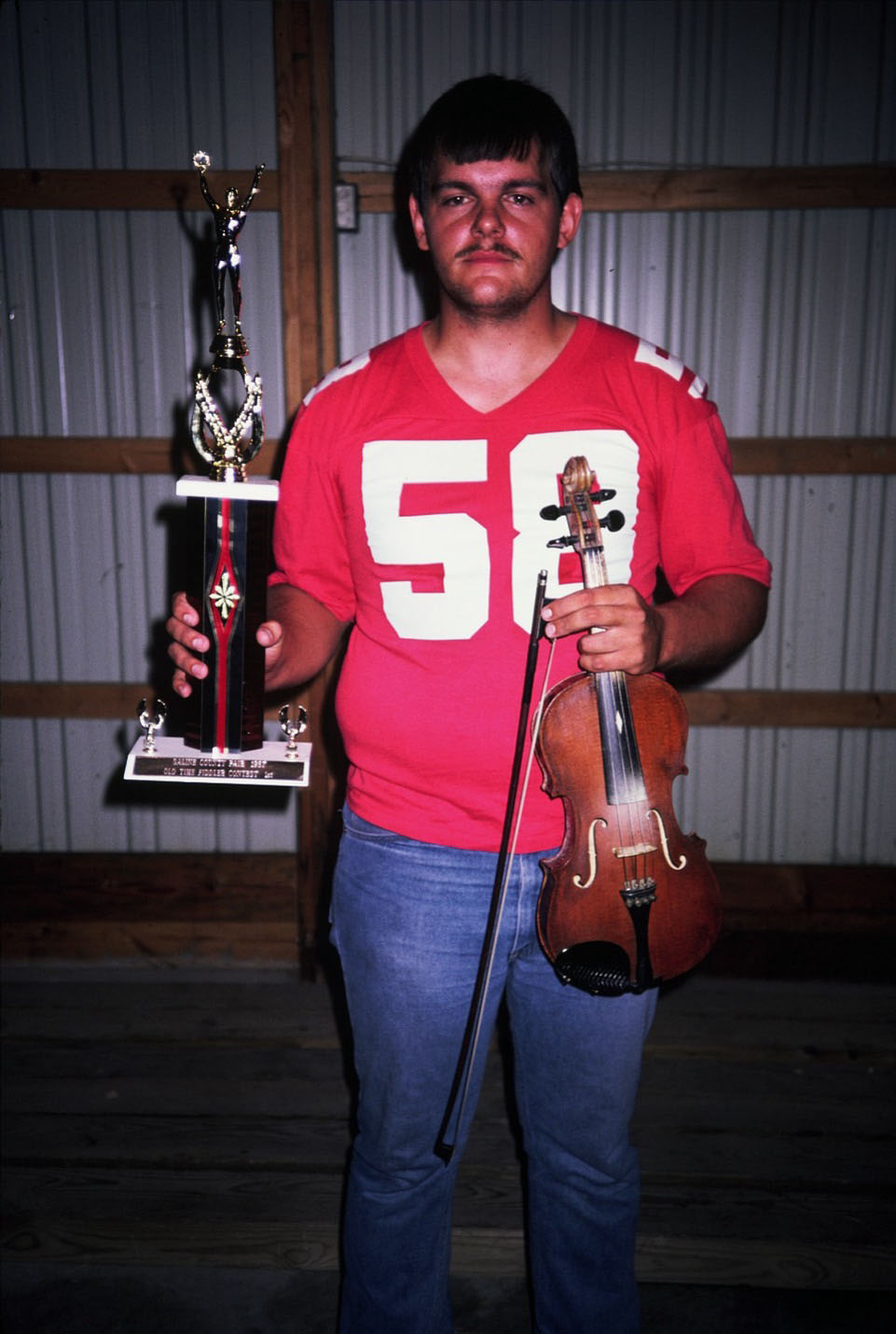
Travis Inman began playing fiddle music at twelve. At twenty-five in 1987, he won first place in the Open Division at the Saline County Fair in Marshall, Missouri. For many years the Marshall contest wase major competition and attracted numerous top-drawer contestants. (Photo by Howard Marshall)
In 1974 Bob Inman took his eleven-year-old son to see some fiddle playing at a contest in the community building at Warsaw, a few miles south of Cole Camp.[12] Held in conjunction with the annual heritage festival, Warsaw paid good prize money and drew top contest fiddlers such as Dean Johnston, Lee Stoneking, and Kelly Jones. Excited by the competition and inspired by “real fiddlers” he saw perform, Travis made up his mind to become a fiddler, too.
Learning was easier said than done. His father owned several violins and did his own repairs, but he was particular about his violins and bows and did not like anyone handling them. “If Dad caught you touching a fiddle of his, he’d thrash you. So, I waited until my mom was outside hanging laundry one day, and I climbed up and looked in the cabinets and found an old fiddle that he taken apart. It had no keys and no strings. I rummaged around in dad’s spare parts and found the keys and put strings on. But I didn’t have any idea how to tune it. I had to get dad’s fiddle out of its case to find out how to tune it. And I used his bow and started sawing.”
Travis began going over to his uncle Othello Smith’s dairy farm, near the Inman farm, and Othello taught him some basic tunes. Travis would go over after school to help milk cows and do chores and then, after supper, “the fiddle would come out” and Othello would play for Travis. Three months later, Travis entered the junior division in the next Warsaw contest and won first place. It wasn’t until then that he worked up the nerve to tell his father what he had been up to. “Dad just flat out didn’t believe me. I had to get the fiddle out and play the tunes for him,” the tunes he played in the contest. “You only had to play three tunes in the competition. It was a good thing, because that’s all I knew.”[13]
Travis’s parents had a record player and he began learning tunes from LPs by laying quarters on the arm above the needle in order to slow a record down enough for him to catch the notes. He listened especially close to Tommy Jackson square-dance LPs from Nashville. The youngster also learned tunes from Sac River Jones, who lived in the area. “Sac was an awful fine fiddle player, an old-time dance fiddler. When I was growin’ up down in there, there was a lot of good fiddle players living up in those hills, you know, dance fiddlers.”
Another influence was Virgil Burns. “Virgil was a monster fiddle player. [His wife] didn’t like him playin’ — so he didn’t own a fiddle. One time he went to a fiddle contest in Cole Camp years ago, when I was a small boy, and he got up there, and he borrowed somebody’s fiddle, and wound up playin’, and won the contest on a borrowed fiddle. That’s what kind of a good player he was. He died when I was in my early twenties, and I never got to spend the time with him that I really wanted to.” Another fiddler was Milton Taylor, a local veterinarian. “Milton played a few fiddle tunes on the fiddle, and when I was a little bitty boy, I used to go over and listen to Milton fiddle. And Milton played the old ‘Blue Mule,’ and he played it in C. And the only people I ever heard play that was him and my great-uncles, the Swearngins.”[14]
Travis spoke about some interesting contests he attended as a child.
They had a fiddle contest years ago up at Cole Camp [in the American Legion fall], where they had a bunch of people, trucking companies, that got together and they had a fiddle contest. Each trucker had to pick a fiddle player to represent them in a fiddle contest. And then the trucking company would wind up gettin’ whatever prizes they got [if their fiddler placed in the prize money]. I was just about that tall. If you knew a good fiddle player somewhere, you’d want him to represent them in the fiddle contest.
And then, they had another one there, at the American Legion, several years later, and I was bigger. And there was a fiddle player come from Boonville, that Musial Wolfe knew, and he was the first man I ever heard play “Orange Blossom Special.” And I thought he did an exceptionally good job on it.
Did you ever hear of Dickie Philips? He played that fiddle on his lap, and could bow that fiddle, layin’ it down and playin’ it flat on his lap, and he just eat it up. He played jazz and everything. One of the finest fiddle players you’d ever hear. He’s been dead for years. He learned to play it like that when he was a little bitty kid and never did change it. But he went to Warsaw to a contest at Jubilee Days, in the late seventies, and you know what kind of fiddlers they had down there, they all come out. I think first place was maybe a hundred bucks. And the damn thing lasted half the night. He showed up down there and was gonna play [in the contest], and they wouldn’t let him play. They would not let him play, because the rules were then that you had to stand up and put the fiddle under the chin. And that was in the Missouri rules. You had to be able to stand up and hold the fiddle under your chin.[15] They wouldn’t let him in the contest, but they had him come out and entertain. And, boy, Dad’s sittin’ there with me and he said, “If that guy had entered it, there ain’t nobody else’d had a chance. He was head and shoulders above everybody else.” Old fella. Man, he could play a fiddle.
As Travis began developing his repertoire, he decided to concentrate on a comparatively small number of tunes instead of trying to learn everything.
I learned just a few tunes and tried to really clean ’em up and play ’em right. Rather than learn to play a hundred and fifty or two hundred of ’em and to just run through ’em. There’s a lot of guys like that. I don’t really understand that — trying to learn every tune you can. I guess it’s okay, but I’d rather play a few and play ’em right — get the parts right, get the right chord changes there, y’know. That was always my thing. I’m interested in all them old tunes but I never sat down and tried to learn every fiddle tune that was out there. I tried to pick out classics. Like these here [tunes on the Jake Hockemeyer 1965 fish fry tape] and try to learn the classic tunes and try to play them really well — something that you could play in a fiddle contest and actually do well with.
You wouldn’t want to play something like “Cripple Creek” in a contest, or “Boil them Cabbage.” You want to play something that’s got some meat and potatoes to it. So I tried to learn those classics and polish ’em up and do well with ’em.
It seems like, as time goes on, if you don’t play those tunes, you lose ’em. I know I’ve lost a lot of ’em. But now I know that if can hear ’em again, if I hear a little bit of it, I can play it, you know. It’ll come right back real fast. I can learn a tune the same way. I can hear a tune and sit down and play it right back to you, but then, by the time I walk out that door, I’ve forgotten it. It comes easy but it goes easy if you don’t play it for a while, get it in there [in your memory].
Kelly Jones was a great help to Travis as he was learning as a teenager. Travis’s father would drive him over to Stover to Jones’s home. Jones was a welcoming, patient teacher and had much to offer. Jones meticulous in his own playing and conveyed that concern for working out “correct” and effective versions of tunes. As recalled in his interview with Amber Gaddy, at Travis’s first visit, “Travis played his newest tune, ‘Flop-Eared Mule,’ for Kelly. Kelly played it back to him, and just ‘played the fire out of it.’ Travis went home with stars in his eyes and a promise of lessons. He says ‘If it wasn’t for him, I wouldn’t have become the fiddler I am. Because he showed me technique’.”[16] Decades later, Travis would again study with Jones, in the Missouri Traditional Arts Apprenticeship Program.
Herman Johnson, the perfectionist Oklahoma champion, was another important mentor. “Herman Johnson, he was one of those kinds of players, that, when he played a tune, you could hear it — it literally rang in your head a week or two after you heard him play it.”
Years ago, back in 1979 or 1980, there was a man and woman in Warsaw, Woodrow and Alma Ferguson. They played music at Silver Dollar City, had a family band. I knew him real well since I was a little kid. So when my dad passed away, he and Alma came up to the house one night, while my mother was livin’ out there on the farm, south of Cole Camp. And Woodrow wanted to give me a horse. And it was a stallion, and I used to go up there and ride it on his farm, it was a really nice horse. And him and his wife asked my mother if they could give me that horse. He had a lot of horses and a lot of big farms that he leased. Momma said, “We can’t let you folks give him a horse, that just wouldn’t be right,” and she didn’t have the extra money to buy the horse from them, so I didn’t get the horse.[17]
They said, “We’re going to Mountain View, Arkansas, and we’d like to take Travis with us, would you let him?” And I was only sixteen at the time. Mother said, “Yeah, you could take him down there, and expose him to that fiddle playing.” Well, when we got to Mountain View, Herman was down there. So that was the first I had met Herman, that was probably about 1979. And boy was I impressed. He was playing good. He was in his sixties. He would stand up there and take requests on stage and play ’em just like he was in a contest. And never miss nothin’. [After Herman Johnson’s performance, Travis introduced himself.] And I got to crowdin’ him a little bit, and asking him to show me stuff, an’ he’d say, “Well, pull that chair right over here by me.” So I’d get as close to him as I could, and watch him. We exchanged phone numbers and we got to be best friends. He’d call me and ask me if I was going to be somewhere [at a contest] and I’d do him the same way, and that’s how I got acquainted with him. Super guy.
Herman wasn’t really a Texas style fiddler player. He wasn’t old-time, but he was kind of — as Junior Marriott’s dad, ol’ Bunny Marriott said, he was a “duke’s mixture.” But I called him a contest style fiddler. He was the only fiddle player to play at Weiser ever to beat Mark O’Connor. He was unbelievable. Like Larry Franklin said on the “Devil’s Box” collection of Texas fiddling: “I knew when Herman Johnson come to Texas [to a contest] that we was in real trouble.”
Herman Johnson was a “monster swing fiddler” and specialized in Bob Wills and the Texas Playboys songs and dance tunes. Listening to Herman play swing one night, Inman realized that he needed to go home and learn to play swing and “do it right. I liked everything he did.” But Travis did not learn by asking Herman Johnson to break tunes apart into phrases. In learning tunes and technique from Johnson, Travis would record Johnson on a cassette recorder. “And I’d have him to play it real slow, just take a tune and play it draggy slow. And then I’d take it home and work on it. And the next time I’d see him, I’d hit him for something else.” Visiting with Johnson at various events, including fiddlers conventions at the Western Hills resort in northeastern Oklahoma near Wagoner, where Texas and Oklahoma fiddling and swing, were dominant, whetted Travis’s appetite for swing fiddle. The jam sessions there were exciting, filling every hallway, nook, and cranny fiddlers such as Oklahoma champions J.C. Broughton and Monte and Dave Gaylord frequented the weekend events. Travis learned “Jumping the Strings” (composed by Byron Berline) from Herman Johnson there one year. Arkansas swing fiddler Frankie Kelly was a regular at Wagoner as well as at fiddlers conventions at Compton Ridge Campground near Branson, where Inman was a regular. Known for his waltz compositions, Inman plays several of Frankie Kelly tunes, such as “Eva Anne’s Waltz.”
In 1998, in album notes for Inman’s Championship Fiddling (similar to the title of Herman Johnson’s first LP), Johnson wrote, “He has the ability to play anything from the very simple to the most difficult tunes with a most pleasing style. His style is of a tonal beauty and melodic accuracy that comes from dedication and hard work.”[18]
Travis won major competitions in Missouri as well in other states. “Boy, going to them fiddle contests, that was really icing on the cake. When I was growing up, up there on the farm, I was a kid. There wasn’t any way of getting any money unless you worked out in the hay — you know, puttin’ up hay and back then it was bucking square bales. And we was always needing money.”
In September 1979, at fifteen or sixteen, Travis thumbed a ride to the state contest in Columbia. Held in the Hickman High School auditorium, this was the first state competition of the Missouri State Oldtime Fiddlers Association. Pete McMahan took first in the hotly contested open division, followed by Jake Hockemeyer and other familiar champions — including a fresh new face on the big stage, Travis Inman. Inman won fourth place, a landmark in his career.
They didn’t have a junior division at that time in the state contest, just open and senior. I didn’t have no way to get there, Dad had just passed away and we lived way back out there south of Cole Camp on a gravel road. And boy it was hot still — September. So, I took off walking up that road with my fiddle case. I had a jar of drinking water, and there was a lady lived out there, she picked me up and gave me a ride to Cole Camp. And I got to Cole Camp, I got out there on the blacktop, started thumbin’ a ride. And I caught a ride all the way to Columbia [c. 80 miles away]. Pete won the contest and he had that gold cup [a large brass traveling loving cup]. And I was standing there licking my chops and thinking, boy, I sure would like to have one of them gold cups.
It was a few years before Inman brought home the state contest cup. A traveling trophy engraved names of winners and years, if a fiddler won three years in a row, he or she could keep the cup, otherwise it was brought back to the contest each year. Names on the cup — Pete McMahan three years in a row, then Jake Hockemeyer in 1982, and Junior Marriott won for the first time in 1983 (Inman came in third in 1983). “Then Pete took it back from Junior” in 1984, and then “Junior took it back from Pete” in 1985. In 1986, the contest moved to the Columbia Fall Heritage Festival in Nifong Park. “And I showed up in ’86 playing “High Level Hornpipe” in B-flat. I had it nice, a salted-down version of it that I thought would work, and it did. I got the cup that year and took it home. And then I wound up winning it in ’87 and ’88 and kept it. And I’ve still got it, and it’s probably my most cherished trophy that I have.[19]
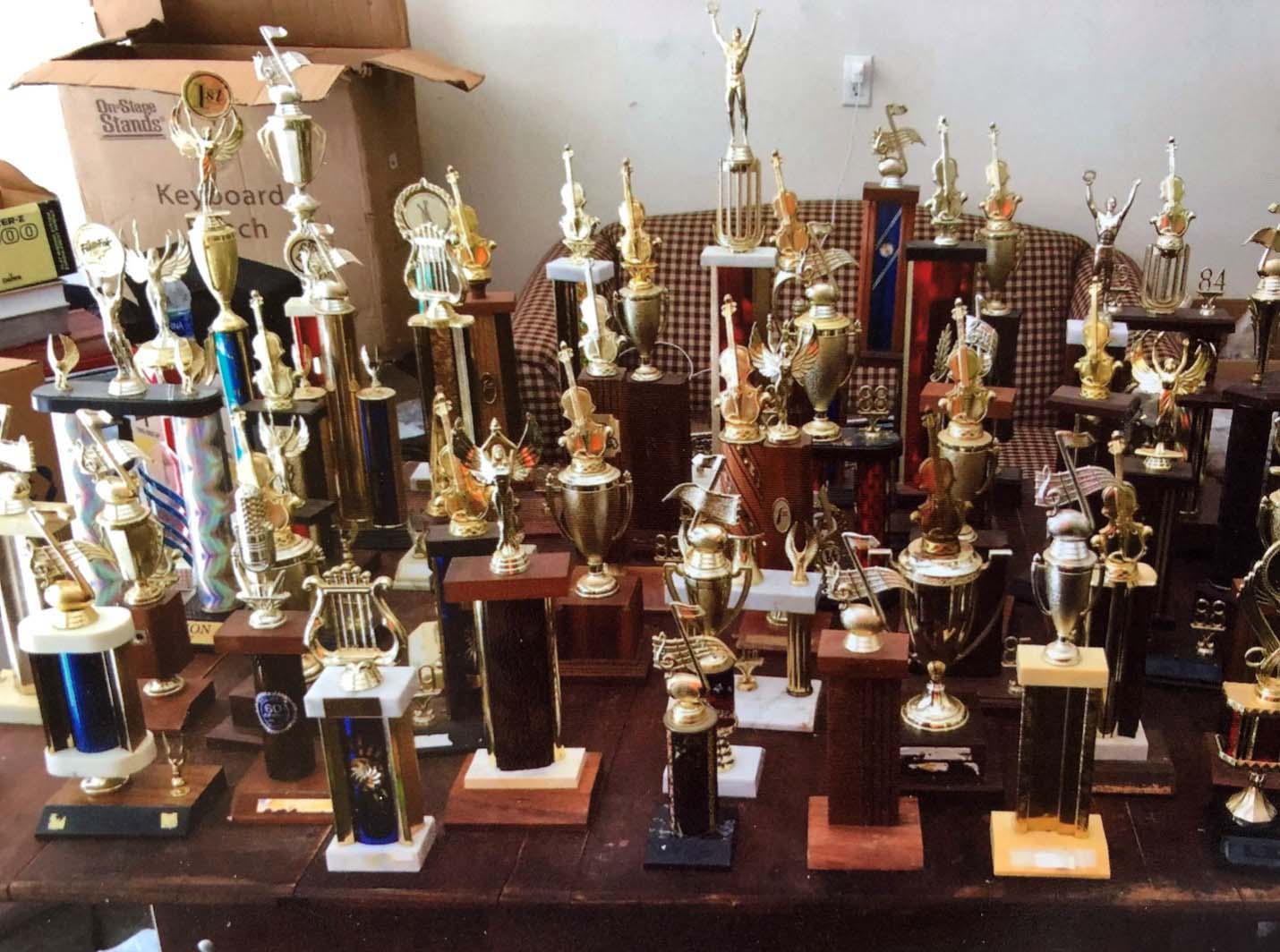
Inman kept some fifty trophies in a storage unit. (Photo courtesy Travis Inman)
Travis alluded to how contests often attracted several top-level fiddlers who all could have won first place. They were well acquainted, and any one of four or five people could win a contest on any given day. Often at contests those top players would kind of “switch it around.” When Travis was a young man, the gang of the older predictable winners in the open division included names such as Pete McMahan, Jake Hockemeyer, and Cyril Stinnett. Audiences did not seem to mind, because they clearly were top contenders. When Travis Inman was himself taking home championship trophies in the later 1980s and 1990s, the predictable winners in the open division at most contests would include, besides Inman, names such as McMahan, Charlie Walden, John Griffin, and Junior Marriott.
Most fiddlers accepted the results of the judging with a good attitude, even though they may be disappointed not to rank higher. Some fiddlers had volatile personalities and could take it personally if the “wrong” fiddler won. At Clinton the year Inman won first place, he beat Ace Sewell, an Oklahoma champion. “And, boy, Ace was mad. And he was drunk. And he was gonna whup me — he was gonna give me a butt-whuppin’ right there on the square. And ol’ Bill Kearns, standin’ right there, turned around and looked and he said, “Ace, you touch that boy and I’ll kick your ass all over this place.” And he [Sewell] didn’t do nothin’ either! I’ll never forget that. He went on [Sewell], he decided that he wasn’t gonna mess with Mister Kearns. I miss that ol’ boy, and I miss Bill Eddy, too.”[20]
Inman remembers his favorite contests as the state competitions developed by the Missouri State Oldtime Fiddlers Association in its early years in the 1980s when the contest was still held in Columbia. Champions like McMahan, Hockemeyer, and McBaine were there and Texas style/ Contest Style had not yet become the winning style in Missouri. “I’ll be honest with you, I went to a lot of ’em. I won a lot of ’em and lost a lot of ’em. But I think the most important contest, to me — not no more — but back when they was holding it in Columbia, the Missouri state fiddle championship, to me was the most prestigious contest that I ever played in. Back when they had the cup in it. I really think it was. Bill Shull and Charlie Walden did it right. I loved it when they’d come down for the contest [the old masters that Travis looked up to]. You know, you give Taylor [McBaine] a good day, and he’d clean your plow for ya. He was dangerous even when he was old.”
Inman competed in the state contest in Tennessee at Clarksville, and the bigger “Tennessee Valley” contest in Athens, Alabama. Both contests have drawn fiddlers from Missouri through the years, including Pete McMahan and Matt Wyatt. Both contests years have also seen the displacement of old-time and bluegrass fiddle styles by Contest Style. Travis was invited in the early 2000s to the Great Plains Championships at Yankton, South Dakota, winning first place in the National Invitational Division fall contest both times he entered, 2004 and 2005.
You know, I went down to Tennessee and won the state contest down there, in ’87, I believe it was. And then I went back, I got invited back to judge. Charlie Butler was runnin’ it. So Herman [Johnson] and I went back down there, I think it was in ’88, and me and Charlie and Herman judged it. Brandon Apple won it that year — boy out of Arkansas — and I think Randy Howard [Nashville, TN] might have got second. I can’t remember — it’s been too long; as they say, too much water under the bridge. And, then, I went to Athens — played there three years ago (2016). I didn’t play well, I didn’t have a good day. I think if I’d have had, I would’ve won it. As many fiddlers as they had, I wound up winning third place. I just didn’t play good. You know how you have off-days and you just can’t find your butt? That’s the way it was that day.
What do I think of today’s Missouri fiddle contests? I guess I’ll just tell you my honest opinion about it. Well, when the fiddlers’ association went out [MSOTFA went on hiatus in the 1990s], they don’t pay the good money that they used to have, y’know. So most generally, the money’s a hundred or a hundred and fifty dollars at best. Then, you gotta deal with all these people who are pure Texas style fiddle players. And then, that’s not so bad, but [now] the judges are Texas style or oriented, too, they lean toward Texas style. So your straight, old-time fiddle player, he’s just kind of left out there, shakin’ his head. So that’s basically what’s happened to the state contest in Sedalia. I know that’s why Kelly quit, and that’s why I quit, and Levi, he don’t care nothin’ about fiddle contests. Since then, Bill Shull has taken over running the Sedalia contest again and, in my opinion, things are back on the level now.[21]
Travis Inman was a fiddler who saw it all, won hundreds of contests, and saw the times change the style of fiddling that gets the most rewards at contests, Travis Inman got the most enjoyment not in contests, but “gettin’ together and having a jam.”
Well, I’ll tell ya what. Back in the eighties, back when the Association was big, we used to drive all the way from Stover plumb up to Montgomery City — where Virgil [Smith] lived — for seventy-five bucks, and never thought nothin’ about it. We never thought nothin’ about the money. It wasn’t about the money in those days. It was about the prestige of going and kicking somebody’s butt. That’s what it was about.[22]
Well, I mean, the way gas is now, yeah, you have to look at the money. I can’t afford to drive that half-ton pickup truck plumb across the state for seventy-five bucks — I’ll be in debt when I get home. But back then, we didn’t care. It wasn’t about the money, back then, you know, gas was probably eighty-nine cents a gallon, and we thought, boy, if Pete’s up there, we gotta go up there and kick his butt. And I know he probably thought the same thing. And Kelly was the same way back then.
We didn’t try to dodge each other. Now, people [fiddlers] try to dodge somebody — “Well, so-and-so’s gonna go over there, so we don’t want to go over there, we’ll go this one over here. That wasn’t the way it was in the eighties, we went to every one we could go to, because we loved the challenge of gettin’ up there dukin’ it out. It wasn’t about the money. But it’s changed, it’s all changed.
Boy, Pete was good, he was hard to beat in them days. And when you beat him, you’d done something.
Let me tell ya a story. I’ll make it quick. When I was starting to play the fiddle contests, and we would go out and play the breakdowns, once in a blue moon we could beat Pete in a fiddle contest. But normally he would win. And when I started out, he’d beat ya eighty-five percent of the time.
Well, I could play good breakdowns, but waltzes wasn’t my forte then. And I told my mother — my dad had already passed away — I said, “I’m gonna have to start doin’ something different if I’m gonna keep doin’ this, because it ain’t worth my time if I keep goin’ the way I’m goin’.”
She said, “Well, what’re you gonna do?” And I said, “Well, I’m gonna have to learn to play waltzes better than he does.” Well, he played them B-flat waltzes and I mean he just ate ’em up.
Well, so I told Mother, she asked me what I wanted for Christmas. And I said, “I’ll tell ya what I want for Christmas, I want to go and pick out about eight or ten of them 33 rpm LPs from Weiser, and I’m gonna learn a bunch of them high-powered waltzes and start playin’ ’em in contests.[23] Well, they weren’t old-time waltzes and they weren’t played up to what they call dance speed, either. They were strictly fiddle contest pieces. And that’s where that “Memory Waltz” came from and the “Yellow Rose” and a bunch of them I used to play all the time, “50 Years Ago Waltz,” “Rosebuds of Avamore.” So, once I learned a bunch of them waltzes and polished ’em up and got the right chord changes behind ’em, it started revolving around the other way — I got to winning a lot more. And then Junior started learning ’em too.
Weiser LPs were recorded by Don Cedarstrom in Boise. American Heritage record company in Caldwell, Idaho, founded by Loyd Wanzer, put out several LPs of fiddlers who were popular at the Weiser contests, including Harold Allen, Bill Long, and others.[24] Travis Inman learned “White Rose Waltz” from Nebraska fiddler (relocated in Oregon), Wanzer, Harold Allen, on his 1960s LP, Waltz Around. Allen composed “Red Fox Waltz,” a favorite among Missouri fiddlers. Another of the big “Weiser waltzes” is Howdy Forrester’s “Memory Waltz” and “Yellow Rose Waltz,” that Travis learned from a Texas Shorty 45-rpm record.[25]
Kelly Jones is one whose waltzes were a vital ingredient in contest success. Unlike Travis, rather that working on complicated waltzes, Kelly Jones chose comparatively spare waltzes and likes old favorites that most people (and judges) recognize, such as “Over the Waves” — and he plays them to perfection.
Kelly never played hard waltzes. He’d play something like “Missouri Waltz” or “Waltz of the Wind” — which is an old Hank Williams song. He’d play something simple and just play it gorgeously beautiful. He would play the real pretty stuff, but he played simple stuff on the waltzes. And he was very smart for doin’ that, because it sure lessens your chances for a mistake. But — if you’re not making a mistake once in a while, you’re not playin’. So we tried to learn the hardest stuff we could. So anyway, that’s how it changed [Travis’s success in contests].
“Finally, Branson just got so Texas, that there was never any way to win it unless you played Texas style.” Did he ever travel to Weiser for the National Oldtime Fiddlers’ Contest? “No. I always thought Weiser might’ve been just a little too far from my house.”[26]
Inman decided to try his luck at a well-advertised fiddle contest at Dixon Mounds, an Illinois State Museum archaeological site and public park near Lewistown. Nile Wilson, Charlie Walden, and others from Missouri attended. Inman thought about what that contest might be like and tried to prepare accordingly.
They had a big fiddle contest up there and it paid good money. And Wes Brown was playing guitar for us then. Wes was a killer guitar player. And Kelly was playin’ fiddle contests strong back then, so me and Kelly rode up with Wes in Wes’s car. And I knew there was gonna be some hellacious fiddlin’ there that day, and I thought, damn, I sure would like to win that money, ’cause it was a good purse. I got up there, and Charlie Walden was one of the judges. And I thought, ahhh, that was gonna make it a lot easier. Charlie knows what he’s listening to. So I played “High Level Hornpipe,” “Garfield’s Hornpipe” (a.k.a. “Blue Water Hornpipe”) and “Ozark Mountain Waltz,” all of ’em in B-flat. Won it. First round, they didn’t have a second round, didn’t even have call backs. Played one round, done. Went home. That was a good ‘un. It was a long ways from the house, but like I say, back then we didn’t care how far we had to drive and the money really didn’t matter that much. It was like, you was just goin’ and beatin‘ somebody.
The mention of what keys work best in competitions brings out strong views. Many contest fiddlers carefully sort their contest repertoire into sets of tunes in different keys, which may help convey to judges one’s versatility (and taste). To some extent the choice depends on the quality of the contest itself, the expected competition that day, and the sophistication of the judges. If the judges were unaware of the difficulty of playing hornpipes in B-flat or F, for example, one might decide to just rip off a hot square dance tune in a “simple” key like G or D. Inman however prefers to play the tough B-flat tunes whenever possible — Howdy Forrester’s “High Level Hornpipe,” for instance, which only elite players play well. Inman felt that B-flat tunes are better in contests, in most cases, as they are difficult and even the best performers run the chance of blundering in a complicated passage in hornpipes like “High Level,” “Golden Eagle,” or “Blue Water.”[27] Now and then, Travis Inman would change things up and play his three tunes in his round in the same key. One year to win at the State Fair at Sedalia, he played “Hell among the Yearlings,” “Country Waltz,” and “Woodchopper’s Hornpipe” – “D chord tunes. I thought they might work if you played ’em really clean, and it worked.”
Inman’s typical selections for a contest round included breakdowns such as “Angus Campbell,” “Grey Eagle, “Tom and Jerry,” “Bill Cheatem,” “Jack of Diamonds,” “Sally Goodin,” “Jack Danielson’s Reel,” “Boil the Cabbage Down,”[28] “Fiddler’s Dream,” “Bitter Creek,” “Sugar Tree Stomp,” “Hooker’s Hornpipe,” “Leather Britches,” “Fiddler’s Dream,” “Woodchopper’s Reel” (a.k.a. “Woodchopper’s Hornpipe”),”Tennessee Wagner,” or “Garfield’s Hornpipe,” (a.k.a. “Blue Water Hornpipe”).[29] For the waltz, Travis typically presented “Fifty Years Ago Waltz,” “Martin’s Waltz,” “Wednesday Night Waltz,” “Memory Waltz,” “Blackhawk Waltz,” (G; a.k.a. “Cabri Waltz” and “Capri Waltz”),[30] “Clark’s Waltz,” “The A Waltz” (a.k.a. “Charlie Cook’s A Waltz”), “Festival Waltz,” “Yellow Rose Waltz,” or “Rosebuds of Avamore.”[31] For his tune of choice, Inman sometimes played “Peacock Rag,” “Pig Ankle Rag” “Red Apple Rag,” or “Cotton Patch Rag.” As swing gained influence in contests, Travis began to play swing tunes such as “Sweet Georgia Brown” rather than a rag.[32]
In 1984, Inman participated in the WOS Reunion to celebrate the legendary fiddle contests broadcast over WOS-AM in Jefferson City in the 1920s and early 1930s. The event was held in state capitol rotunda in Jefferson City and included fiddlers and accompanists who had been in original WOS contests.[33] Travis won first place in the Open Division (Cecil Goforth, second; Henry Thompson, third) and Pete McMahan won first in the Seniors. In Columbia in 1989, Inman took part in the Cope Ashlock Invitational Fiddle Contest, a mock competition that aired live over KOPN 89.5 FM.
The Apprentice Becomes the Master
Inman was an instructor for years at the Bethel Fiddle Camp and in the Traditional Arts Apprenticeship Program and has given private lessons. The lessons and teaching method he absorbed from Kelly Jones stayed with him. “That’s the way I teach students today.”
In 1989, Travis was Jones’s apprentice in the TAAP program. The program usually requires that the pupil have at least the rudiments of playing a violin in hand. First, student and teacher discuss what tune is to be tried and worked on, which implies a fiddle tune that both people know, or that the teacher knows and knows the student wants to learn.
Back in the 1970s when Inman learned from Jones, Jones would first play a fiddle tune through in its entirety and then slow down the tune and repeat it carefully. He would then ask Travis to play it, or any parts of it he had a grip on. He then would work on troublesome patches — going phrase by phrase: play it for Travis, listen to Travis play it back, make suggestions, “and repeat.” Then the phrases are pulled together, resulting in the whole tune.
In the TAAP program, students are expected to record lessons so they can study the recordings before the next lesson. Ear training is very important, and Jones urges students to listen, to use their ears more than their eyes. Rote replication of a teacher’s version of a tune is not encouraged but often this is a useful first step toward the student internalizing the music and technique and then, as it matures, evolving their own interpretation that, at best, is both a quotation of the taught melody and personal expression. “I teach Levi Roden that way. I’ll play him a phrase [a few notes] and make him play it back to me. And if he messes it up, I’ll make him go back and do it again. And we’ll do that over an’ over an’ over an’ over, if it takes him fifty times. But it never does, he gets it about the third time through. He gets it quick.” Inman’s students in the TAAP program have included Roden, Clayton Beal, Olivia and Carlie Cunningham, Brett Dudenhoeffer, Amanda Murphree-Roberts, and Liz Kehl.
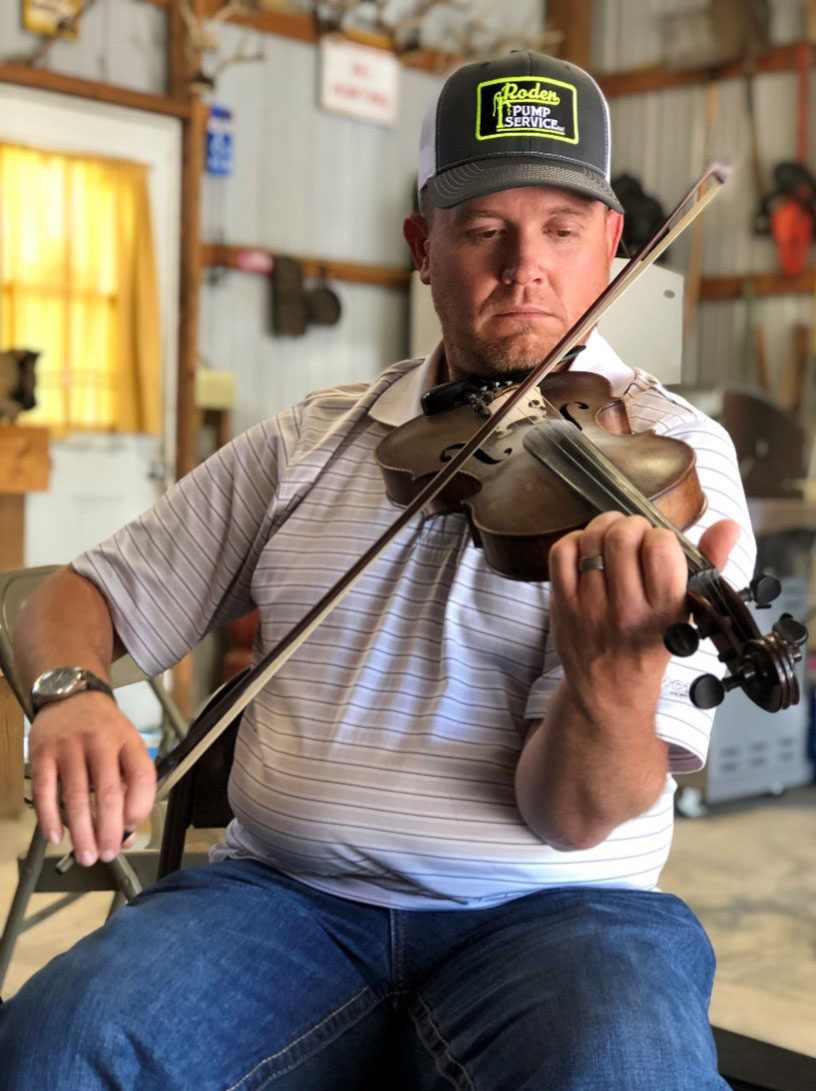
Levi Roden at a jam session in Steve Roden’s machine shed, Purdy, Missouri. (Photo by Howard Marshall, May 2019)
Levi Roden. Levi Roden of Purdy, in southwest Missouri’s Barry County, born in 1982, started lessons with Travis Inman in 1993. Roden became fascinated with fiddling at age eleven. His great-grandfather, Dick Roden, gave him a violin, and Levi’s real inspiration was seeing Travis in 1993 at a hootenanny in a country schoolhouse in McDowell, a few miles east of Purdy. Levi and his father, Steve, had attended some of the hoots there, which featured bluegrass bands and country singers; they enjoyed the shows, but the music did interest Levi. Hearing Travis warm up in the back, getting ready to play when his turn came, hit Levi like a lightning bolt. Steve and Levi introduced themselves to Travis and within a short time Steve began driving Levi to Travis’s house for fiddle lessons.[34]
The fiddle music Roden heard before meeting Inman was mainly the contest-oriented fiddling of Herman Johnson and others. “It was great, but it was all contest fiddling, and that’s it.” There seemed to no one around Purdy playing old-time fiddle. Levi’s grandfather, Leroy Harris, played the guitar. After getting started with Inman in 1993, Steve took Levi to the Bethel fiddle camp some three hundred miles away in northern Missouri. Levi then apprenticed with Inman in the TAAP program in 1996 and 1997. An “ear musician” and quick learner, Roden proved an able student and became a contest champion in his own right. Long after their TAAP lessons, Roden continues to learn from Inman, and they continue to get together to play.
In May 2019, Travis invited me to a jam session in Steve Roden’s machine shed with Travis, Levi Roden, their cousins Andy Harris (guitar) and Rick Harris (bass). Levi and the Harrises play in a country music and gospel band. When I asked Travis what the fiddling would be like, he said, “There won’t be no Texas fiddling at this jam session. It’ll be old-time fiddle tunes that day!”[35]
Inman remembered square dances at Ava, and how Bob Holt played ultrafast in order to please the dancers there. Travis played for an Ava dance once. [You] “Play ‘Boil the Cabbage Down’ and the sweat just drippin’ off ya, and an old man standin’ in front of me [gesturing at Travis] and goin’ ‘faster, faster!’ Hell, he looked like he was about to have a stroke. Finally, I told that one old man, ‘I’ll tell ya what, have you ever heard of Lee Stoneking?’ I said, ‘You need to take a listen to some of his music. Ain’t nobody played any more square dances than he did. Lee Stoneking never got in a hurry‘.”[36]
Levi talked about going to Bethel as a teenager in the 1990s, and the square dances in the evening led by Edna Mae Davis and her Ava group. Campers played for dancers in the evenings, often alongside instructors. Bob Holt was an instructor at the time and Roden, a young fiddler playing a lot of Texas style, was uncomfortable with Holt’s ultrafast hoedown tempo.
Roden: “I couldn’t stand it because they played so stinkin’ fast. I mean it was fast — nine hundred miles an hour for nine hours.”
Inman: “You know, Bob Holt would have been an awfully good fiddler if he’d have played about half that fast.”[37]
Roden: Another thing I didn’t ever understand. For a square dance, they would play one tune for about an hour. That got old to me real quick, y’know. I remember, Bob Holt was up there and he would sit there with his left hand on the knee and he’d sit there like this forever. Played with just the tip of the bow, too. Hours, hours.[38]
Travis Inman’s “Angus Campbell,” a hornpipe composed by J. Scott Skinner for his Harp and Claymore (London 1904, p. 94), and popular in Britain, Ireland, and Canada; a frequent contest piece in central and north Missouri from the 1960s to the present time. (Transcription by Sharon Graf)
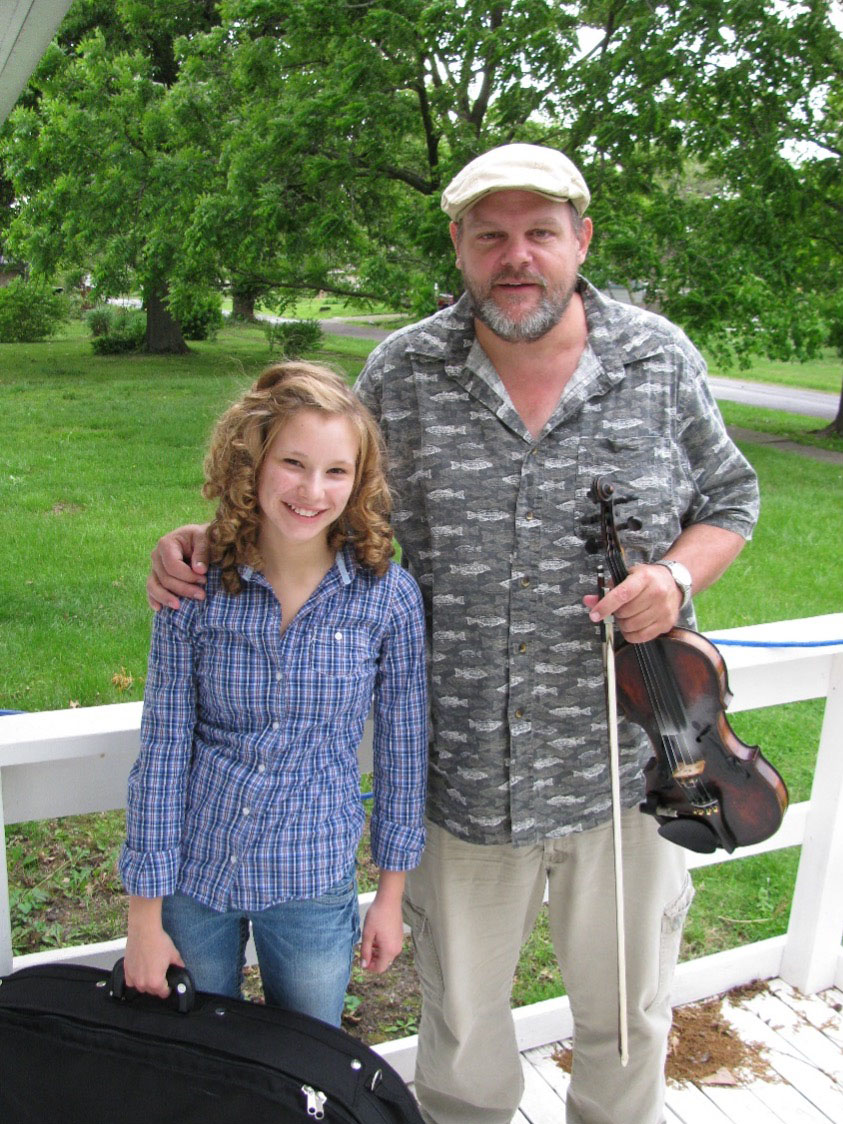
Travis Inman with Olivia Cunningham in the Traditional Arts Apprenticeship Program at Inman’s home in Sedalia. Olivia and her sister, Carlie, studied with Inman and have been active at square dances and fiddle contests. (Photo by Howard Marshall, April 2012)
Olivia Cunningham was Inman’s student in the TAAP program in 2011-2012, as was her younger sister, Carlie, Inman’s apprentice in 2015-2016.[39] Olivia Cunningham of Fulton (the family has a livestock and horse farm near Millersburg) had played at Hallsville dances, taking a turn as lead fiddler. A confident youngster, Olivia had no problem providing the rhythm and music to keep the dancers happy. The Cunningham sisters were active at contests, too, doing well in the junior division. The girls’ parents, Cammie and Gary Cunningham, administered fiddle contests in Callaway County until the Covid-19 pandemic put them on hiatus in 2020.
I asked Cammie Cunningham, mother of the four Cunningham girls, about their years studying fiddle with Travis Inman and also about their summer weeks at Bethel Fiddle Camp.
As Cammie explained, “Olivia and then Carlie began classical violin when they were three and three-and-a-half. Sophia began when she was four. By the time Olivia was 10 she was beginning to lose interest in classical music, so I bought a fiddle tunes book thinking this might keep her interest. Her violin teacher encouraged the fiddle playing alongside the classical instruction. Since Olivia and Carlie were reading music, they just picked a tune from tune books and learned it by listening and reading the music.” In 2008, the Cunninghams heard about the youth fiddle camp at Bethel. “Olivia and Carlie attended that June. Sophia came a few years later when she was old enough. Marta started playing violin when she turned five. She didn’t have the formal instruction like the other three had but learned at home; the girls taught her fiddle tunes.”[40]
On the TAAP application with Olivia, Travis listed tunes he proposed to teach, several of which she already knew but needed help improving, Missouri standards, favorites of Inman’s, and tunes Olivia asked that they work on. Some are titles chosen for contests. The tunes were, “Fifty-Years Ago Waltz” (“Anniversary Waltz”), “Swearngen’s Hornpipe,” “Clark’s Waltz,” “Back in Old Arkansas,”[41] “Wednesday Night Waltz,” “Bill Cheatem, “Grey Eagle,” “Kiss Me Waltz,”[42] “Cowboy Waltz,” “Hooker’s Hornpipe,” “Gypsy Hornpipe” (from Kelly Jones, Cyril Stinnett, Casey Jones), “Mississippi Sawyer,” “Red Apple Rag,” and “Ragtime Annie.” On the sampler tape with their application, the tunes are, Inman, “Fifty Years Ago Waltz,” “Miss McLeod’s Reel,” and “Granny Will Your Dog Bite;” Cunningham: “Down Home Rag” (from Vesta Johnson at Bethel fiddle camp), an untitled waltz, and “Whisky Before Breakfast.”
Among elements in fiddling that Inman stresses are the importance of getting “drive,” old-time phrasing, character, and accent into one’s playing. Travis asked Olivia to “snap it up,” make her playing more like “fiddling” than like repetitious rote learning. This is sometimes difficult for classical players, and essential if one is to become a fiddler as well as a classical violinist. As most pupils do, Olivia asked Travis what is “the right way” to play a certain passage or tune. Travis would show her the notes and play it through, but was careful to repeat the truism that there is no “right way” in this music. Perhaps because Inman has been a contest fiddler for so many years, his style now exhibits elements of Contest Style in versions of standard tunes. It is hard to avoid doing that. Thus, by teaching his Contest Style versions of tunes, students learn a contest style but one related to the older Little Dixie Missouri style.
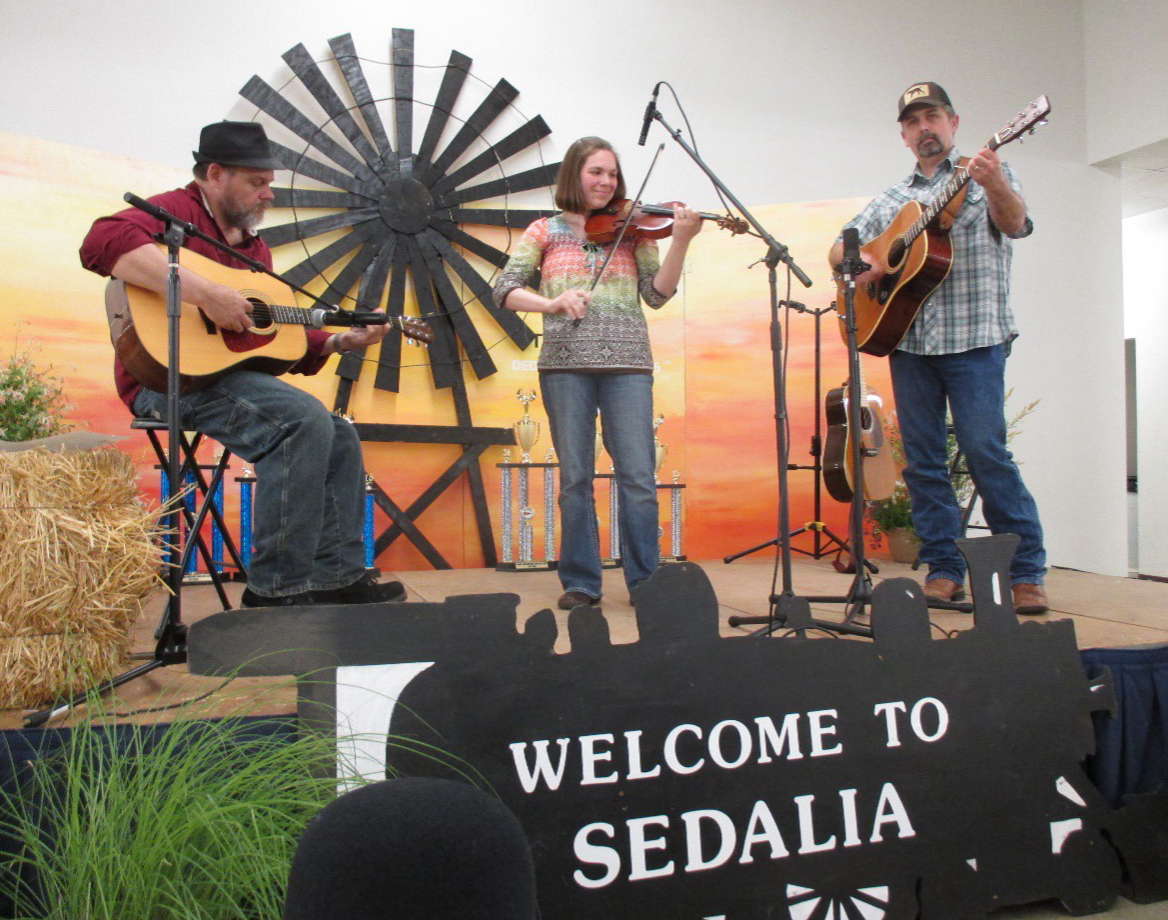
Liz Kehl was Travis Inman’s student in the TAAP program in 2015. Here, Liz plays her round in a contest at the Trails End Days festival in Sedalia, April 2015, “Angus Campbell,” “Clark’s Waltz,” and “River Road-Step” (learned from Inman); her guitar accompanists were Inman (left) and Junior Marriott. (Photo by Howard Marshall)
Liz Kehl of Smithton (b. 1982) played viola in the Lee’s Summit school program and won honors in state school contests. After marrying and having children, her family moved to her husband’s family farm in southeast Pettis County. While in college at Missouri State University in Springfield, Liz played violin and guitar for church, and attended fiddle contests, where she met Travis Inman. Liz decided to enter a contest in Bunceton, and played “Fort Smith,” “Ashoken Farewell,” and “Irish Washerwoman.” “Travis came up to me while I was warming up and asked where I was from and if I needed an accompanist. I said yes, and we practiced some. Junior Marriott and Travis both accompanied that contest performance, if memory serves me correctly. After my performance, Travis asked me if I would be interested in some fiddle lessons. I agreed, and we exchanged information. He taught me a couple of lessons before bringing up the TAAP program. I chose to apply for the program because at that time affording lessons would have been very difficult. I was very interested in expanding my musical training to incorporate fiddling.”[43]
One of the tunes Liz worked on was “Marmaduke’s Hornpipe,” a classic Missouri tune with Civil War history long been popular in fiddle contests. “In this particular tune, he taught me a ‘“lick in ‘Marmaduke’s Hornpipe’ that was handed down to him from his Uncle Othello. I really enjoyed playing this, because it was something I hadn’t heard, even in fiddle contests. Travis taught me the uncommon tunes, not the ‘standards’ often heard repeatedly in contests today. I remember learning ‘Gilsaw,’ ‘Marmaduke’s Hornpipe,’ ‘Rachel,’ and others that are not often heard in contests these days. This is what fiddling and TAAP is all about.” Liz continues performing on viola in school programs and special occasions, plays fiddle in local jam sessions and postcontest sessions, and gives lessons in both classical violin and old-time fiddling.
Travis Inman retired after almost twenty years of employment at a corporate dog-food processing factory, where he was a jack-of-all-trades, maintaining equipment, driving forklifts and trucks, and pushing buttons on computerized machines.
For many years, Travis played dances and country music shows in Missouri, Kansas, and Oklahoma, in places such as the Truman Lake Opry at Warsaw, the Moose Lodge at Sedalia, and the Treasure Lake RV Park at Branson, where patrons enjoy buffet dinners and dancing. He played weekly senior-citizen dances with a country band at the Saline County fairgrounds at Marshall. Musicians in these bands are seldom more than part-time, often older or retired, and personnel continually change; they do not play this music for money, although pay at the end of the evening is welcome.
Several years ago, Travis quit competing in contests but helps judge or emcee when asked. He continued recording and reissued his earlier records (see Discography) and continued offering fiddle lessons.
Travis Inman’s enthusiasm for making music did not abate and he never stopped learning. Thinking back to tunes he felt he still needed to polish up, Travis said he planned to sit down and work out Pete McMahan’s “Turkey Knob,” a tune Pete learned from a Clark Kessinger LP back in the 1970s and used to good effect in contests.[44] “I’m still workin’ on it. Pete? That old rascal was hard to beat.” –You and Pete both, Travis. Travis Inman died in February 2022.
Travis grew up listening to the great fiddlers who defined Missouri fiddling. And that influence was always evident in his playing even after he developed his own contest style which for the most part was unlike the prevailing Weiser-derived style. He was his own man and played the way his instincts led him. And damn, what good instincts he had.[45]
[1] Unless otherwise noted, Travis Inman quotations come from an interview by Howard Marshall and Margot McMillen in Wheatland, Missouri, May 10, 2019. I appreciate Inman’s help, in preparing this chapter, and help from his cousin, Diane Peck.
[2] April 10, 2011.
[3] [3] Inman, March 10, 2011.
[4] Hazel Inman’s mother’s maiden name was Della Swearngin; memorial notes, Hazel Lucille Inman, https://www.findagrave.com.
[5] [5] Tahlequah is the location of tribal headquarters of the Cherokee Nation. Travis Inman notes that the name is spelled in various ways, with most spellings as “Swearingin” and “Swearingen,” but Travis’s branch spell the name “Swearngin.” Some family members spell the name “Swanigan.” Travis’s Swearngin branch of the family “are not on the Dawes Rolls [the Oklahoma tribal headquarters’ roster of officially-sanctioned Cherokee names], because they didn’t make it that far; they escaped from the Trail of Tears somewhere in northern Arkansas and moved north into Missouri. Kate apparently died on the reservation in Oklahoma in the 1950s” (Amber Gaddy interview, April 12, 2012).
[6] See N. Julian Castro, “From the Tennessee River to Tahlequah: A Brief History of Cherokee Fiddling,” Chronicles of Oklahoma 67, no. 4 (2009-2010), 400; Castro mentions Travis Inman in the West Plains Ozark Heritage Festival on-line promotion from the 2006 event: “Travis Inman, a renowned, award-winning fiddle player, came from a family steeped in the tradition of performers such as John ‘Doc’ Swearingen [sic.] and Kate Swearingen; the latter was the Oklahoma state fiddling champion in the 1920s.”
[7] [7] The obituary for John D. Swearngin, Jr. (1940-2011), called “Doc,” is available via the Davis-Miller Funeral Home, Lincoln, Mo.; Doc Swearngin was born in Warsaw, Mo.
[8] Gaddy interview with Inman, April 12, 2012; Inman’s composition, “John Swearngin’s Hornpipe,” is named for his great-uncle.
[9] Performer profile, Old-Time Music Ozark Heritage Festival, West Plains, June 2008.
[10] Robert F. Inman served as a Private First Class in the U.S. Army in World War II.
[11] Crockerville (“Crocker” in local usage) was an unincorporated hamlet east of Cole Camp in Benton County; there is a town called Crocker in the Ozarks west of Dixon (Pulaski County). The exact details of the chainsaw incident are not known to this writer.
[12] It may have been 1975, and Travis’s first contest at Warsaw the following year may have been 1976; such details are often unclear in oral tradition; in oral history, the location and the event are more important to people then the precise date of the event.
13] [ Performer profile, Old-Time Music Ozark Heritage Festival, West Plains, June 2008. This contest was the 1975 Warsaw Jubilee Days contest. Travis fiddled “Boil the Cabbage Down,” “Maple Leaf Waltz” (learned from an LP of Canadian waltzes), and “Old Joe Clark” and won first in the junior division.
[14] Gaddy interview. Inman learned “Billy in the Low Ground” from Virgil Burns, whose wife was a Cherokee woman from Oklahoma; their farm was about ten miles from the Inman family’s farm. An Uncle Dave Macon song, “Old Blue Mule” was recorded by Lonnie Robertson, Art Galbraith, Bob Holt, Glenn Rickman and others in the Ozarks; I recorded Rickman, of Crane, Missouri, fiddling it in 1975 in visit for the Smithsonian’s Festival of American Folklife; Gordon McCann recorded Rickman playing the tune in 1980 and it is transcribed in Beisswenger and McCann, Ozarks Fiddle Music, 112.
[15] That rule may have appeared in Warsaw rules but I have not encountered it elsewhere (nor in Warsaw contests in which I participated). Richard (Dickie) Phillips (1920-1991, Sedalia, Pettis County) began playing fiddle at age four by holding the violin in his lap and bowing left-handed. He performed professionally playing guitar with such nationally-popular bands as Spike Jones and his City Slickers, country star Tex Williams, in orchestras for Pat Boone, and appeared on the Arthur Godfrey TV show; his unorthodox method of playing guitar has been likened to playing piano. Phillips was also a well-known pedal steel guitar player in country music.
[16] Gaddy interview.
[17] As Jim McGreevy recalls, Woodrow and his three daughters performed at Silver Dollar City before 1978. “The girls were all pretty good musicians — probably played more than just one instrument, and sang very well. I guess Woody was the fiddler.” One of daughters married Arkansas fiddler Cotton Combs (McGreevy, January 31, 2021).
[18] Inman, Championship Fiddling (1998). Herman Johnson’s two influential LPs are Champion Fiddlin (American Heritage P-120, 1968, the year of his first national championship at Weiser) and National Champion (John’s Music 86-34, 1978); for transcriptions and a CD, see Orme, Herman Johnson.
[19] Inman learned “High Level Hornpipe” as a teenager from Canadian fiddler Graham Townsend’s LP, Championship Fiddle Favorites (1964, 1969); Inman, May 19, 2019. Most fiddlers of my acquaintance point to Howdy Forrester’s records as their source.
[20] Bill Kearns was a tall, stout, railroad brakeman; a genial fellow, Bill could appear intimidating under the right circumstances; Kearns and his friend, Bill Eddy (both from Slater, Missouri), were solid old-time fiddlers of the older generation, from Saline County, and frequent contest participants and judges.
[21] Marshall interview, Inman, May 10, 2019, March 10, 2021.
[22] At most contests in Missouri in the 2020s, the purse is similar to the purse fifty years ago; inflation has rarely caught up with prize money. By custom in Missouri, fiddlers give their accompanists 20% of whatever amount of money they win (however many accompanists there are, the 20% is divided among them).
[23] “Weiser records” is shorthand for the compilation LP records produced in the 1960s and 1970s of contestants at the National Oldtime Fiddlers’ Contest in Weiser, some of whom were excellent waltz players. “Memory Waltz” was composed by Nashville fiddler Howdy Forrester and played by numerous fiddlers at Weiser and everywhere else across the continent; “Yellow Rose Waltz” was popularized by Texas Shorty (Jim Chancellor) on a 45 rpm record (Goldenbow GO-1016-2, c. 1960). Among Charlie Walden’s videos posted on YouTube are Kelly Jones playing “Memory Waltz” at Bethel Youth Fiddle Camp in 1988, and Travis Inman playing “Yellow Rose Waltz” at Bethel in 2014.
[24] Vivian Williams, March 3, 2021.
[25] Inman, May 19, 2019, March 3, 2021. Harold Allen, Waltz Around (American Heritage AH-401-506); “Yellow Rose Waltz” does not appear on any of the LP records produced by the National Oldtime Fiddlers’ Contest itself from 1966 to 1979 (Vivian Williams, February 5, 2021).
[26] Inman said that he would like to go to Weiser, a three-day trip by automobile and some 1.700 miles, after he turns sixty in 2023 (when he would have qualified for the Senior Division).
[27] “Blue Water Hornpipe” is the regional folk title for this tune; its title in tune books is “Garfield’s Hornpipe” or “President Garfield’s Hornpipe.” Named in honor of U.S. President James A. Garfield (assassinated in 1883), this great tune was composed by Harry Carlton and published in 1883 in Ryan’s Mammoth Collection (p. 137) and repeated verbatim in Cole’s 1000 Fiddle Tunes in 1940 (p. 101); it is in Charlie Walden’s list of “100 Essential Missouri Fiddle Tunes.” Stinnett helped popularize the “Garfield’s” title in the 1960s; among some fiddlers, whether one uses the “Blue Water” or “Garfield’s” title indicates the fiddler’s source for knowing the tune; if one uses “Blue Water,” it is most likely that the fiddler is principally an ear musician.
[28] “Boil the Cabbage Down” is a common square dance tune that is usually considered too simplistic to impress judges; but some contest fiddlers have made a point of evolving the old chestnut into a highly improvised, extended, and complex piece — with “meat and potatoes” — that can charm judges.
[29] Inman announced the tune in contests as “Garfield’s Hornpipe” in case judges are not aware of its regional title. “Blue Water Hornpipe.”
[30] The original title is “Cabri Waltz,” a Canadian tune named for the town in Saskatchewan; the title is often mistaken as “Capri Waltz,” and “Blackhawk Waltz” is an alternate title in the folk process of shifting tune titles. Joe Pancerzewski’s “Cabri Waltz” is on the 1972 Voyager LP, The Fiddling Engineer (VRLP 302) and Pete McMahan’s version, mistakenly titled “Capri Waltz” is reissued on McMahan’s 50 Old-Time Fiddle Gems.
[31] “Rosebuds of Avamore” is one of the region’s alternate titles for a fine waltz called “The Rosebud of Allenvale” by Scottish fiddler and composer, J. Scott Skinner in the 1920s; sometimes fiddlers use Howdy Forrester’s title for it, “Rose of Sharon.”
[32] In former times, a fiddler might play a schottische, polka, or jig as the tune of choice but rags have become more dominant (with the occasional polka) as one’s tune of choice, with their potential for display of improvisational, jazzy and swingy performance. In the 2020s, the only time a schottische, march, air, or a jig is apt to be heard is when a contest fiddler decides to make an “old-time” statement and let the scoresheets be hanged.
[33] Walden, “Radiophone WOS and WOS Radio Reunion and Fiddling Championship.”
[34] Inman, March 10, 2021.
[35] Inman, April 14, 2019.
[36] Inman, May 19, 2019.
[37] Bob Holt did not fiddle that fast in his younger years; when he lived in Iowa, he played bluegrass and country music. Later, in Ava, Missouri, he played faster to please square dancers there, and he was typecast in the 1980s as an ultrafast “Ozark” fiddler by arts councils, festivals, collectors, and program agencies; Bob went along with the typecasting, and many young fiddlers learned from Bob and adopted his speedy tempos.
[38] Holt’s sitting position helped him endure long square dances at Bethel, made longer than usual because fiddle campers were being taught to square dance with the seasoned dancers. Bob Holt had a time limit of seven minutes for a square dance, which he would enforce when the occasion called for doing so. He would lay his wristwatch on the floor between his feet and keep track. When five or six minutes elapsed, Bob would begin giving the square dance caller focused stares and nods, and these physical motions signaled the caller that the dance was reaching his time limit and that he would be winding down the tune when the time reached seven minutes.
[39] Sophia Cunningham was an apprentice of John Williams in the Traditional Arts Apprenticeship Program in 2017-2018. Among articles about the Cunningham girls, who are homeschooled, are Katherine Cummings, “Youth Keep Fiddling Heritage Going,” Fulton Sun, August 7, 2012; “Fiddling Sisters are Four of a Kind,” Fulton Sun June 28, 2015; Helen Wilbers, “Cunningham Sisters Learn to Play Fiddle Together,” Fulton Sun, August 24, 2017
[40] Cammie Cunningham, February 7, 2021; the tune book the Cunningham girls have is David Brody’s Fiddler’s Fakebook.
[41] A Frankie Kelly waltz popularized by Lee Stoneking and Fred Stoneking; Kelly’s chord progressions in his waltzes are sometimes complex and include key changes; as Travis said, “It goes into netherland” (May 19, 2019).
[42] An old tune that was dressed up and popularized by Kenny Baker on Bill Monroe’s 1972 Uncle Pen (Decca DL7-5438) and frequently played in Missouri fiddle contests by Taylor McBaine, whose version was admirable.
[43] Kehl, February 18, 2021. “I have four children. My oldest two were born in Springfield, and the younger two in Sedalia, around the time I was studying with Travis.”
[44] Inman, June 19, 2020; the recording is the 1971 LP, The Legend of Clark Kessinger (County 773); Fred Stoneking also played a sterling version of this great tune.
[45] Jim Ruth, February 8, 2022.